Compliance is no longer a periodic project completed before an audit.
It is an ongoing responsibility shaped by clients, insurers, vendors, regulators, contracts, privacy expectations, industry standards, and emerging technologies.
CTN Trust helps leadership understand its obligations, establish practical controls, maintain defensible evidence, and remain ready as requirements change.
Many mid-market organizations do not consider themselves regulated. They may still be expected to meet formal security and compliance requirements before they can:

These expectations may arrive through contracts, procurement processes, insurer applications, customer reviews, vendor agreements, privacy obligations, and industry relationships. The organization may not have chosen the requirement. It is still responsible for meeting it.
CTN Trust helps leadership identify those pressures early and turn them into clear operating responsibilities before they delay business, increase liability, or damage important relationships.
An organization may have written policies, annual training, security tools, and a compliance binder. That does not confirm that the controls described in those materials are operating consistently.
The real questions are:

Compliance gaps often exist between what has been documented and what occurs in daily operations. CTN Trust helps close that distance.
Drew’s compliance perspective emphasizes that apparent readiness on paper can hide weaknesses in identity, monitoring, data governance, accountability, and continuity. Those are business risks, not simply administrative deficiencies.
The first step is understanding which requirements, risks, and business relationships affect the organization.
CTN may evaluate:
The objective is not to produce an overwhelming list of deficiencies.
It is to identify meaningful gaps, explain their business implications, and establish a practical order of operations.

Organizations often face overlapping expectations from several sources.
A single security control may support:
CTN Trust helps map these expectations into a clearer requirements structure.
This can help leadership understand:
Requirements mapping reduces duplication and helps prevent compliance work from becoming a collection of disconnected checklists.
Compliance cannot remain the informal responsibility of whoever happens to be available.
Leadership needs clear answers to questions such as:
CTN Trust helps establish governance structures, decision rights, ownership, reporting, and review cadences. The goal is to keep risk visible and make accountability sustainable.
Policies should reflect how the organization actually operates.
CTN Trust can help develop, organize, and maintain practical documentation covering areas such as:
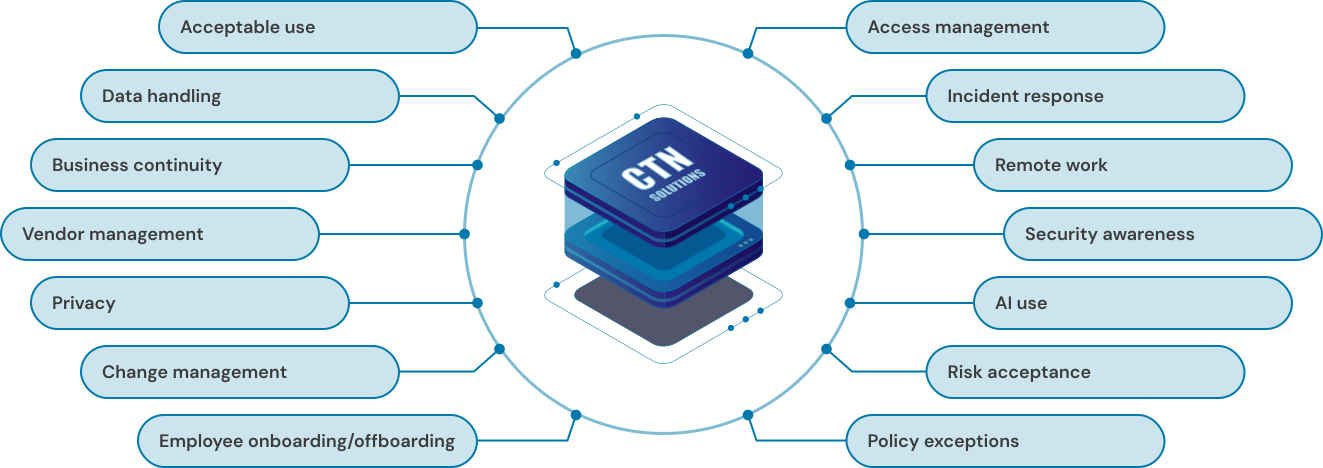
Documents should be understandable enough for employees to follow and specific enough to support accountability.
A policy that no one uses does not strengthen the organization.
Many organizations have security and operational controls but cannot clearly explain or demonstrate them.
CTN Trust helps document:
This connects written expectations with operating reality.


When an insurer, auditor, client, regulator, or partner asks for proof, leadership should not have to begin searching through email inboxes and individual folders.
CTN Trust helps organize evidence such as:
Evidence should be current, accessible, understandable, and connected to the requirement it supports.
Audits, examinations, client reviews, and insurer requests are more manageable when readiness is maintained continuously.
CTN Trust can support:
The objective is not simply to prepare for one event.
It is to build an operating model that remains more defensible throughout the year.
Enterprise customers increasingly require suppliers and partners to demonstrate appropriate security and governance practices.
Organizations may be asked to complete:
Failure to respond effectively can delay onboarding, weaken negotiations, or eliminate an organization from consideration.
CTN Trust helps leadership understand what is being requested, identify supporting evidence, address material gaps, and create a more consistent response process.
Cyber insurance applications may require specific representations about:
CTN Trust works with CTN Shield and Core to help determine whether the controls represented to an insurer are active, documented, and governed.
Insurance should not become the only time leadership reviews the organization’s security and compliance position.

Vendors can affect the organization’s security, compliance, privacy, continuity, and reputation.
CTN Trust can help establish a repeatable process for understanding:
Third-party risk is part of CTN Operating Framework because the organization remains accountable for important dependencies beyond its own walls.
Compliance changes as the organization changes. New employees, applications, vendors, clients, locations, regulations, contracts, and AI tools can all affect the organization’s obligations and controls.
CTN Trust helps maintain readiness through recurring:
Compliance should become part of how the organization operates, not something it temporarily performs.
The CTN industry materials consistently frame Trust as an ongoing structure of assessments, documentation, evidence, and leadership governance rather than a one-time audit project.
Identify the requirements, stakeholders, business relationships, information, systems, vendors, & risks affecting the organization.
Connect requirements with the policies, controls, people, processes, and technology responsible for fulfilling them.
Establish practical policies, procedures, control descriptions, ownership, and reporting.
Maintain organized evidence that shows how responsibilities are being managed.
Create recurring leadership visibility, review, accountability, and decision-making.
Address findings and adapt the program as requirements and business conditions change.
Continuous compliance does not mean that every issue is resolved immediately.
It means the organization has a reliable process for knowing where it stands, identifying priorities, documenting decisions, and improving over time.
Leadership has a clearer understanding of which requirements apply and why they matter.
Responsibilities are assigned rather than assumed.
The organization is more prepared to support its claims with current documentation and proof.
Client, vendor, insurer, audit, and due-diligence requests become more manageable.
Compliance priorities remain visible to executives and boards.
Written requirements are connected to actual operating controls.
The organization is better prepared for audits, assessments, incidents, insurance renewals, and changing expectations.
Leadership can make decisions based on evidence rather than assumptions.
The NextGen Strategy identifies compliance readiness, governance, executive confidence, and enterprise readiness as organizational capabilities CTN should help leadership build.
Compliance supported by stable systems, operating documentation, lifecycle management, access administration, vendor coordination, and reliable daily practices. Core helps maintain the environment in which many controls operate.
Requirements and policies supported by active cybersecurity controls, monitoring, incident preparation, awareness, and resilience. Shield helps operate protections. Trust helps govern and demonstrate them.
AI adoption supported by defined policies, data governance, vendor review, human oversight, privacy protection, and accountability.
Access to compliance leaders, program managers, cybersecurity professionals, auditors, project specialists, and other expertise required to maintain the program.
Readiness reviews, requirements mapping, risk prioritization, executive reporting, governance design, and strategic oversight.
These capabilities reinforce one another because compliance depends on the complete organization, not one department or technology tool.
Cybersecurity focuses on protecting systems, information, users, and operations.
Compliance focuses on understanding obligations, establishing governance, documenting controls, maintaining evidence, and demonstrating that responsibilities are being fulfilled.
An organization may have security tools without a mature compliance program.
It may also have extensive compliance documentation without active and effective security controls.
CTN Trust and CTN Shield work together to connect:

This creates a more defensible position than either technology or documentation can create independently.
AI is already entering business workflows through approved initiatives, software updates, vendors, and individual employee use.
Organizations need to consider:

Which tools are permitted

How sensitive data is protected

How vendors use organizational data

How bias and accuracy are addressed

Which laws, contracts, or policies may apply


What information employees may enter

Whether outputs require human review

Who approves use cases

How decisions are documented

How use is monitored
Enthusiasm is not a governance framework.
AI does not reduce the organization’s accountability. It increases the need for clear ownership, policies, oversight, and evidence.
CTN Trust works with CTN Edge and Shield to help organizations pursue AI opportunities responsibly.
Financial organizations face regulatory examinations, client expectations, vendor-risk obligations, continuity requirements, and the need to demonstrate defensible controls. CTN Trust can support risk assessments, control documentation, third-party reviews, evidence preparation, examiner response, and recurring leadership governance.
Healthcare organizations must connect HIPAA policies with the actual controls protecting PHI and supporting clinical operations. CTN Trust can support risk analyses, policies, Business Associate Agreement processes, vendor reviews, centralized documentation, audit responses, and ongoing governance.
Manufacturers increasingly face customer questionnaires, OEM expectations, supplier assessments, cyber insurance requirements, and combined IT and operational technology exposure. CTN Trust can help document controls, prepare for customer and insurer reviews, and connect risk management with supply-chain relationships.
Professional services firms face confidentiality obligations, client-contract requirements, vendor assessments, insurer expectations, and growing scrutiny around sensitive information. Trust helps firms develop practical policies, organize evidence, answer questionnaires, and maintain leadership visibility.
Nonprofits must respond to boards, funders, insurers, privacy expectations, grant obligations, and the responsibility to protect donor and constituent information. CTN Trust helps translate risk into language leadership can understand and maintain through practical governance.
Engaging CTN Trust does not require replacing every advisor or internal resource.
CTN can work:

CTN’s role is to help operationalize requirements across technology, controls, documentation, vendors, people, and governance.
Legal interpretation and formal certification responsibilities should remain with the appropriately qualified legal, regulatory, or auditing professionals.
A Trust conversation may be appropriate when:
You do not need to know the name of every applicable framework before beginning.
CTN can help identify the pressures affecting the organization and determine the appropriate next step.
Begin with a clear view of where the organization stands.
The Compliance and Cyber Readiness Review is designed for organizations that need to understand:
The NextGen Strategy specifically identifies a Compliance Gap Assessment as a high-value advisory entry point that can lead naturally into CTN Trust when ongoing support is needed.
Maintain readiness as the organization changes.
Some organizations have policies, providers, and legal guidance but lack a consistent operating cadence for maintaining compliance.
An ongoing Trust relationship may include:
This gives leadership a continuing view of compliance without treating every assessment, renewal, or customer request as a new emergency.

CTN has helped organizations navigate changing technology, cybersecurity, operational, and compliance responsibilities since 1997.
The future Trust proof framework should include:

Proof should focus on how CTN helps leadership reduce uncertainty, improve readiness, protect important relationships, and maintain accountability.

“The amazing thing, and probably the best aspect of their service, is that CTN removed me from day-to-day IT tasks. CTN is very all our needs. Our employees now work directly with their help desk, and I have gained valuable time to focus on other aspects of my job. They are my employees and teaching them.”
“CTN Has Made My Job A Lot Easier.”
“The amazing thing, and probably the best aspect of their service, is that CTN removed me from day-to-day IT tasks. CTN is very all our needs. Our employees now work directly with their help desk, and I have gained valuable time to focus on other aspects of my job. They are my employees and teaching them.”
“CTN Has Made My Job A Lot Easier.”
“The amazing thing, and probably the best aspect of their service, is that CTN removed me from day-to-day IT tasks. CTN is very all our needs. Our employees now work directly with their help desk, and I have gained valuable time to focus on other aspects of my job. They are my employees and teaching them.”
“CTN Has Made My Job A Lot Easier.”

Compliance as a Business Strategy
Compliance is often treated as a requirement to manage at the lowest possible level. That approach overlooks its connection to revenue, reputation, insurability, client trust, business continuity, AI governance, and enterprise value.
In this executive brief, CTN Founder and CEO Drew Morrisroe explains:
This resource is based on Drew’s existing compliance thought-leadership material.
Begin with a conversation about your organization’s requirements, clients, vendors, insurance, policies, controls, evidence, AI use, and leadership concerns.
CTN will help determine whether the appropriate next step is:
Compliance should not be measured by whether the organization has a binder.
It should be measured by whether responsibilities are understood, controls are operating, evidence is available, and leadership can demonstrate that the organization is being governed responsibly.